
Lyndsey Hendriks
TOFWERK, 스위스
Plastic pollution is a global issue due to the persistence and ubiquity of plastics in the environment. An estimated 10 % of all produced plastic ends up as fragments in aquatic systems. Microplastics (MPs- plastic particles less than 5 millimeters in size) originate from the breakdown of larger items, such as microbeads in personal care products, or synthetic fibers from textiles. These particles are widespread in the environment, found in oceans, freshwater systems, soil, and even in the air we breathe. They pose a significant threat to ecosystems and human health by accumulating toxic chemicals and acting as vectors for contaminants.
Advanced analytical tools are crucial for detecting and characterizing microplastics to better understand their effects on ecosystems and human health. Repurposing single-particle inductively coupled plasma mass spectrometry (sp-ICP-MS) for microplastics detection offers several advantages. It provides different analytical information such as particle mass, which can be used to determine size distribution, as well as particle number concentration, which is crucial for accurately identifying low concentration microplastics in the environment. Additionally, when using a time-of-flight (TOF) mass analyzer, all elements are measured simultaneously. This enables the determination of the elemental composition of particles, revealing associated metal additives or contaminants.
Reluctance to use sp-ICP-MS for these types of analyses comes from its low sensitivity for carbon and high background. However, when optimized for carbon specifically, sp-ICP-MS overcomes these limitations, allowing effective microplastic detection. By applying sp-ICP-MS to complex environmental samples, we can enhance environmental monitoring and support regulatory efforts. This approach advances research and innovation, contributing to more effective solutions for addressing plastic pollution.
Microplastic Detection Using the icpTOF
When operating all of our icpTOF models (S2, R and 2R) in standard (STDS) mode, mass-to-charge ratios (m/Q) from 14 to over 254 are transmitted with good efficiency [1]. However, when analyzing lower masses such as lithium, boron, beryllium or in this case, carbon, tuning adjustments are necessary to optimize the transmission of these low-mass ions. This is achieved by applying low-pass settings on the RF quadrupole ion guides, which favor the transmission of low-mass ions, making it possible to achieve the full mass range from m/Q 7 to 280 [1-3]. This tuning is applicable to all of our icpTOF models.
The first step in this case study was to optimize the instrument to detect carbon, the primary component of plastic particles. The operating conditions are shown in Table 1. Additionally, the single-cell sample introduction (SC-SIS, Glass Expansion Inc., Australia), which is specifically designed for transporting larger particles, like cells, making it ideal for this study involving MPs. Subsequently, commercially available monodisperse polystyrene (PS) beads with a nominal diameter of 4 μm were used as model microplastics to calibrate the systems. Utilizing TOFpilot and its dedicated single-particle workflow [4] — which includes analyte selection, particle thresholding, split event correction, background subtraction and quantification [5] — the particle signals were identified and quantified on the icpTOF S2.
| Parameter | Typical value for all icpTOF models |
|---|---|
| Nebulizer Flow [L min-1] | 0.4- 0.5 |
| Sheath Gas Flow [mL min-1] | 235 to 325 |
| Auxiliary Gas flow [L min-1] | 0.8 |
| Cool Gas Flow [L min-1] | 14 |
| Sampling Depth [mm] | 5 |
| Plasma Power [W] | 1550 |
| Angular Deflection [V] | -360 to -330 |
| CCT Mass [V] | 100 to 140 |
| CCT Bias [V] | -6 to -8 |
| CCT1 Flow [mL min-1] | 0 |
| Notch Amplitude [V] | 100 to 130 |
Results
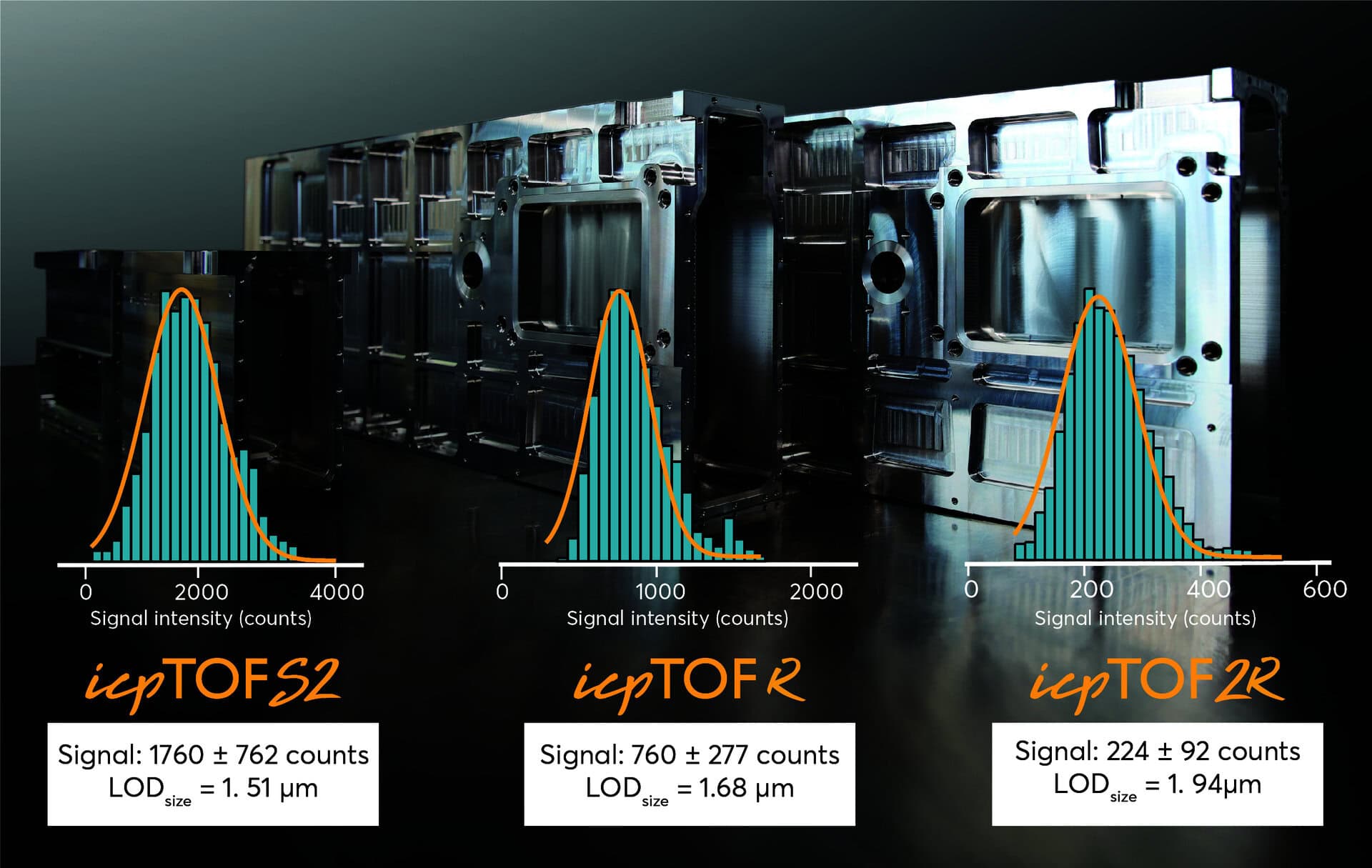
Using monodisperse 4 μm PS particles as model microplastics, the performance of the different icpTOF configurations was assessed. Figure 1 highlights the differences in sensitivity between the three icpTOF models (icpTOF S2, icpTOF R, and icpTOF 2R). While the icpTOF S2 possesses maximum sensitivity and is ideally suited for the detection of small particles, the icpTOF R and icpTOF 2R models can also be effectively optimized for microplastic detection, making them competitive options in this field too.
The strength of this method lies in the different types of analytical information that sp-ICP-TOFMS can provide from very simple measurements as shown in Figure 2. Using adequate calibration, this approach allows to quantify the measured signals into mass of carbon, and then size assuming a known density for PS (ρ = 1.04 g/cm3) and a spherical geometry. Besides mass and size information, this approach also allows for ionic background concentration determination (concentration of carbon per water volume) as well as particle number concentration (number of particles per water volume).
The strength of this method lies in the different types of analytical information that sp-ICP-TOFMS can provide from very simple measurements as shown in Figure 2. Using adequate calibration, this approach allows to quantify the measured signals into mass of carbon, and then size assuming a known density for PS (ρ = 1.04 g/cm3) and a spherical geometry. Besides mass and size information, this approach also allows for ionic background concentration determination (concentration of carbon per water volume) as well as particle number concentration (number of particles per water volume).

This case study demonstrates the effectiveness of sp-ICP-TOFMS using the suite of TOFWERK icpTOF instruments in analyzing 4 μm PS particles as proxy for microplastics, highlighting its potential for accurate detection, mass, respective size quantification and particle counting.
Outlook and Perspective for Microplastic Detection
The field of microplastic detection has seen significant advancements, driven by innovative strategies. By exploring and expanding the capabilities of sp-ICP-TOFMS, new potential for nanoplastic detection can be unlocked. A key approach includes 12C-detection, which leverages the intrinsic carbon content of microplastics and has been validated by several studies [2, 3, 6]. Another promising strategy is multi-elemental fingerprinting, which characterizes microplastics through their unique elemental compositions, including metals and pigments, offering a comprehensive analysis of microplastic compositions [7]. Lastly, metal-tagging of nanoplastics, where specific metals are used as tracers, has been shown to enhance detection sensitivity significantly. This approach involves doping nanoplastics with metals, enabling precise detection and quantification even in complex environmental samples [8, 9].
All together, these innovative methods collectively offer promising avenues for improving the environmental monitoring of microplastics and significantly improve the sensitivity and selectivity of sp-ICP-TOFMS for nanoplastics.
참조
[1] Hendriks et al., J. Anal. At. Spectrom., 2017, 32, 548-561. DOI: 10.1039/C6JA00400H
[2] Haricky S. & Gundlach-Graham A., J. Anal. At. Spectrom., 2023,38, 111-120. DOI: 10.1039/D2JA00295G
[3] Hendriks L. & Mitrano M. D., Environ. Sci. Technol. 2023, 57, 18, 7263–7272. DOI: 10.1039/D2JA00295G
[4] “TOFpilot- Integrated Control Software for the icpTOF”, White Paper, TOFWERK 2020.
[5] Pace H. E. et al, Anal. Chem. 2011, 83, 24, 9361–9369. DOI: 10.1021/ac201952t
[6] Vonderach, T., et al, Anal Bioanal Chem, 2024, 416, 2773–2781. DOI: 10.1007/s00216-023-05064-0
[7] Baalousha M., et al, Environ. Sci.: Nano, 2024, 11, 373-388. DOI: 10.1039/D3EN00559C
[8] Mitrano, D.M., Beltzung, A., Frehland, S. et al.. Nat. Nanotechnol., 2019, 14, 362–368. DOI: 10.1038/s41565-018-0360-3[8] Mitrano, D.M., Beltzung, A., Frehland, S. et al.. Nat. Nanotechnol., 2019, 14, 362–368. DOI: 10.1038/s41565-018-0360-3
[9] Hendriks L. et al, Environ. Sci.: Nano, 2023,10, 3439-3449. DOI: 10.1039/D3EN00681F
