
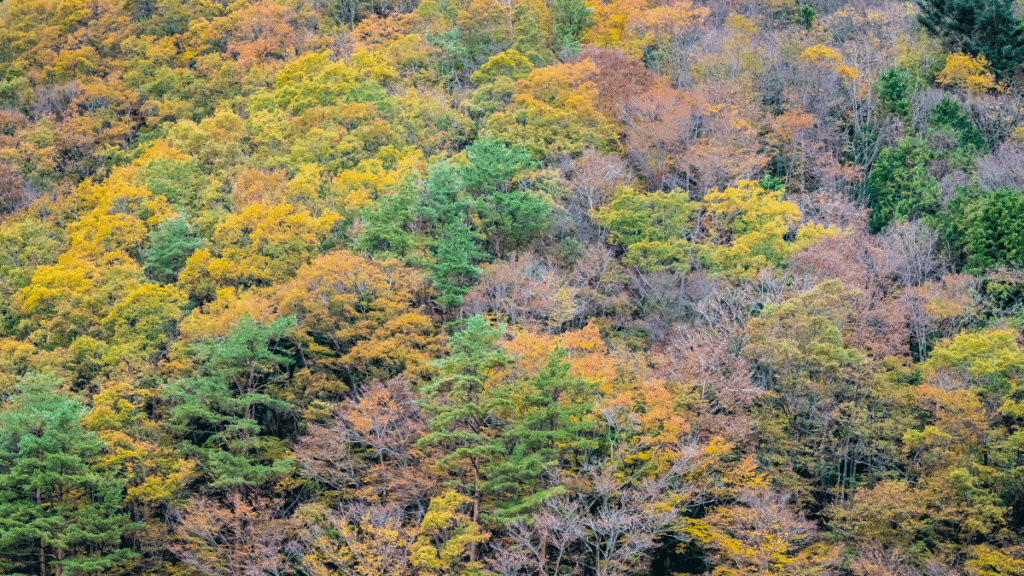
Researchers use real-time mass spectrometry to study biogenic volatile organic compounds in Japanese forests.
Research Overview
This research introduction video, led by the Yokohama City University Laboratory for Mass Spectrometry and Atmospheric Environment, showcases work from the “Plant Climate Feedback” project under the Grant-in-Aid for Scientific Research for Scientific Transformation, Ministry of Education, Culture, Sports, Science and Technology. The video documents a summer 2024 survey measuring real-time biogenic volatile organic compounds (BVOCs)—the “smell” emitted by plants—in a Quercus forest in the Shirakami Mountains.
You are currently viewing a placeholder content from YouTube. To access the actual content, click the button below. Please note that doing so will share data with third-party providers.
More InformationThe Science Behind Plant-Climate Interactions
Forests cover about 30% of the Earth’s land surface and support a wide variety of plant species. These plants are influenced by climate, but they also play a role in affecting it. As climate change progresses globally, the timing of plant growth and sprouting is shifting.
Plants respond to changes in climate while also contributing to climate regulation through the emission of biogenic volatile organic compounds (BVOCs). These naturally produced chemicals can influence atmospheric conditions and climate processes.
However, there is still much we do not know about which plant species emit specific types of BVOCs, when they are released, or how these patterns vary across seasons. To address these gaps, the research team is carrying out a project aimed at improving our understanding of the feedback mechanisms between plants and the atmosphere.
Research Methodology and Locations
The research team has established monitoring systems at two key sites:
Shirakami-Sanchi: Researchers have installed a monitoring system featuring TOFWERK Vocus 2R and Scout instruments to collect data over several months. This data is then used as input for atmospheric modeling.
Hirosaki University Nature Park: At this riparian (water-adjacent) forest site, researchers directly measure BVOC emissions using a TOFWERK proton transfer reaction mass spectrometer (PTR-MS). This mobile device is capable of measuring forest-emitted gases in real time.
Their setup captures samples from various forest layers, including the canopy and understory, using eight 50-meter-long Teflon tubes connected to the PTR-MS instrument. This allows the researchers to determine which BVOCs are being released in different parts of the forest in real time.
Research Goals and Applications
The goal is to determine whether certain species, previously thought to emit only small amounts of BVOCs, may in fact be major contributors. Such a finding would have important implications for our understanding of plant-atmosphere interactions.
By observing how BVOC emissions vary under different weather conditions, the researchers can begin to describe these changes as functions. These relationships can then be integrated into climate models.
By incorporating these measurements into atmospheric models, the researchers aim to improve our understanding of how plant emissions influence the climate system. This, in turn, can help us better predict future climate changes as plants both respond to and affect their environment.
Real-Time Measurement Technology
The TOFWERK Vocus technology enables researchers to measure forest-emitted gases as they are released, providing the capability to capture the dynamic nature of BVOC emissions from different forest layers simultaneously.
